
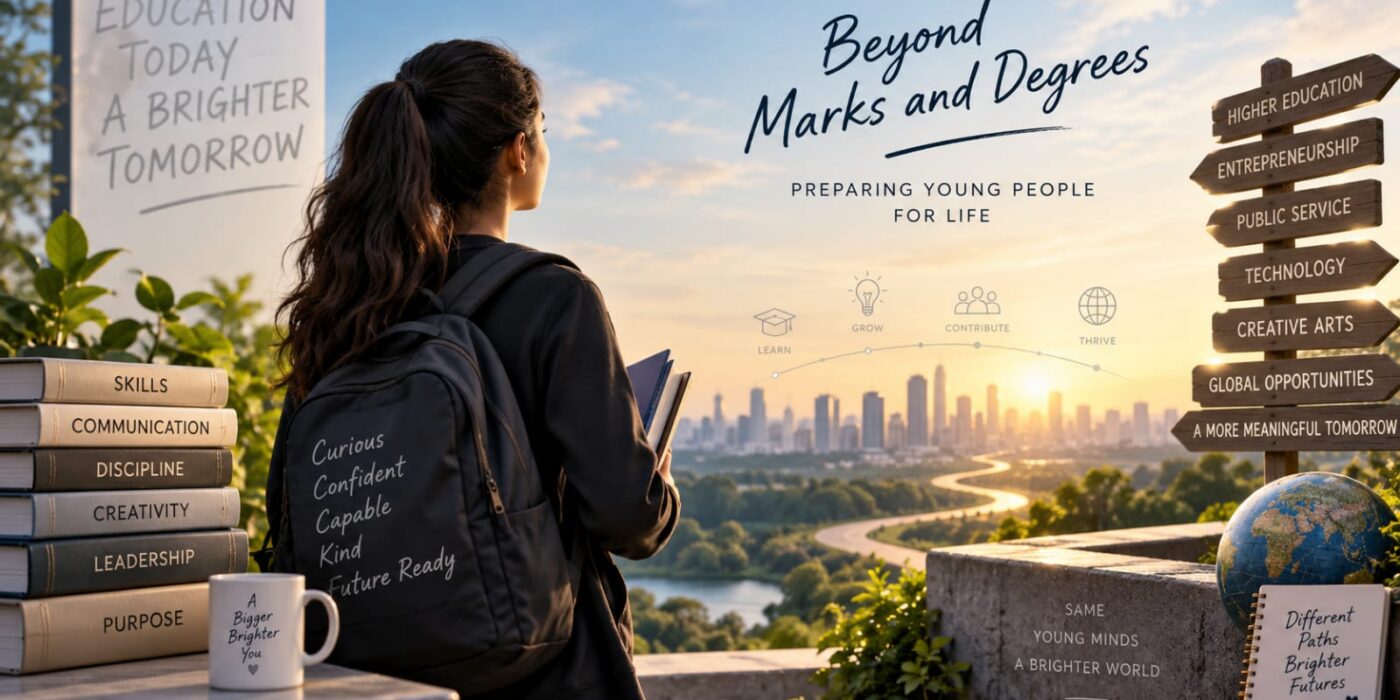
For more than fourteen years, I have had the privilege of being associated with education and interacting closely with young minds.
And if there is one lesson those years have taught me, it is this:
Education and preparation for life are not always the same thing.
Our classrooms teach mathematics, science, languages, history and countless other subjects that form an essential intellectual foundation. Yet, as students step beyond those classrooms, life begins asking questions that rarely appear in an examination.
What are you good at?
What kind of work will give meaning to your abilities?
How do you respond when your first career choice does not work?
How do you communicate your ideas?
How do you adapt when technology changes your profession?
And perhaps the most difficult question of all:
Who do you want to become?
These questions have shaped much of my thinking as an educator and, eventually, my journey as a co-author of Careers Decode Blueprint.
Marks Matter—but They Don’t Tell the Whole Story
For generations, academic achievement has understandably been regarded as an important indicator of progress.
A good academic foundation matters.
But marks measure performance within a particular system at a particular moment. They cannot completely measure curiosity, resilience, creativity, emotional intelligence, communication, leadership or courage.
During my years in education, I have seen students with very different personalities and abilities.
Some shine immediately.
Others take time.
Some are excellent academically but struggle to identify what they genuinely want.
Others may appear ordinary within conventional evaluation systems but possess extraordinary creativity, interpersonal ability or entrepreneurial instinct.
The responsibility of education, therefore, cannot simply be to identify who scores the highest.
It must also help every learner discover where they can contribute best.
Career Guidance Must Begin Before Career Confusion
We often begin serious conversations about careers when students are already expected to make major decisions.
Choose a stream.
Choose a degree.
Choose a competitive examination.
Choose a profession.
Suddenly, a teenager is expected to make choices that may influence decades of life.
But career awareness should not begin with a form that needs to be filled.
It should begin much earlier—with exposure.
Young people need opportunities to understand professions, industries, entrepreneurship, public service, emerging technologies, vocational careers, creative fields and the changing nature of work.
They should know that a career is not simply a designation.
It is an evolving intersection of aptitude, opportunity, skills, values and purpose.
The World Our Students Are Entering Is Different
The workplace awaiting today’s students is changing extraordinarily fast.
Artificial intelligence is transforming how we research, communicate, design, analyse and make decisions. New professions are emerging while established professions are being redesigned.
This does not mean young people should fear technology.
It means they must learn something even more important than mastering a particular tool:
how to keep learning.
The ability to learn, unlearn and relearn may become one of the most important professional capabilities of this generation.
Schools and families therefore need to gradually shift the conversation from:
“Which job will you get?”
to:
“Which capabilities are you building?”
Jobs can change.
Capabilities travel with us.
Communication Is a Career Skill
My own journey has repeatedly reinforced the importance of communication.
A brilliant idea that cannot be expressed may remain unnoticed.
Knowledge without the ability to communicate it can limit influence.
And competence without confidence can prevent talented individuals from entering rooms where they deserve to be.
Students should therefore be encouraged to speak, write, question, present, collaborate and listen.
Communication is not merely about speaking fluent English or delivering impressive presentations.
It is about learning to express an idea with clarity and understand another person’s perspective with empathy.
That capability matters whether someone becomes a teacher, scientist, entrepreneur, administrator, artist or corporate professional.
Discipline Creates Possibilities
My experience in gymnastics taught me another lesson long before professional life reinforced it.
Talent matters.
But discipline determines what we eventually do with talent.
Sport teaches us to practise when nobody is watching, to accept correction, to recover after failure and to understand that improvement often happens gradually.
These lessons extend far beyond athletics.
Careers are rarely built through one extraordinary moment. They are usually built through hundreds of ordinary days when a person continues learning, practising and showing up.
Young people need motivation.
But they need discipline even more.
There Is No Single Definition of Success
One of the most damaging pressures young people experience is comparison.
Someone gets into a prestigious university.
Someone clears an examination.
Someone launches a business.
Someone moves abroad.
Someone achieves financial success early.
Digital platforms can make everyone else’s life appear to be moving faster than our own.
But careers are not races conducted on identical tracks.
People begin with different circumstances, discover themselves at different ages and succeed in different ways.
For one person, success may mean entrepreneurship.
For another, public service.
For someone else, research, teaching, agriculture, technology, art or social impact.
A meaningful career is not necessarily the one society applauds the loudest.
It is one in which ability, opportunity and purpose gradually begin to meet.
Why We Need a Broader Career Conversation
This philosophy became particularly important while working on Careers Decode Blueprint.
Career guidance cannot merely be a catalogue of professions.
Young people need to understand the larger ecosystem around careers—education, skills, government opportunities, emerging technologies, entrepreneurship, global possibilities and the realities of a changing economy.
More importantly, they need permission to explore.
Choosing one direction today should not create the fear that every other door has permanently closed.
Modern careers are increasingly dynamic.
People will change roles.
Some will change industries.
Some will become entrepreneurs after years of employment.
Others will return to education later in life.
Reinvention will increasingly become normal.
Preparing Young People for Life
After years of teaching, learning, communicating and working across different professional roles, my understanding of education has become both simpler and broader.
We must prepare young people not merely to pass examinations, but to face uncertainty.
Not merely to seek employment, but to create value.
Not merely to acquire information, but to develop judgment.
Not merely to compete, but to collaborate.
Not merely to follow established paths, but to have the courage to build new ones when necessary.
A successful education should leave a young person with more than a certificate.
It should leave them with curiosity to keep learning, confidence to keep exploring, discipline to keep progressing and values strong enough to guide their choices.
Because ultimately, the purpose of education is not simply to prepare someone for their first job.
It is to prepare them for a lifetime of becoming.
— Richa Dahiya
Educator | Author | Entrepreneur | Life Coach